
Indo Western Dresses for Women: 10 Styles and How to Choose the Right One
Ten Indo Western dress styles for women, from dhoti sets and cape gowns to pant sarees and jacket lehengas, with simple advice on occasion, fabric and fit from our custom stitching studio in Greater Noida.
2 November 2026 · 10 min read · Indo Western Boutique
Indo Western dresses for women have moved well beyond the occasional fusion experiment. Today they are worn to mehendis and cocktail nights, to office Diwali parties and family functions, and even as a reception outfit by brides who want something different from a heavy lehenga. The appeal is easy to understand: you get the richness of Indian fabric and embroidery with the ease and clean lines of Western tailoring.
The trouble is that "Indo Western" covers a huge range of outfits, and it is not always clear which one will suit your event, your body and your comfort. In this guide, our design team at Indo Western Boutique in Greater Noida walks you through ten styles we stitch most often, what each one is best for, and how to choose between them.
If you are completely new to fusion wear, you may also like our beginner's guide to Indo-Western fashion.
What makes a dress "Indo Western"?
An Indo Western outfit takes one element from Indian dressing and one from Western dressing, and builds a single look around both. It might be a traditional fabric such as Banarasi silk cut into a Western silhouette like a jacket or gown. It might be a Western shape such as a crop top or cape worn with an Indian piece such as dhoti pants or a lehenga skirt. Or it might be a classic Indian drape, like the saree, reworked with pants, a belt or pre-stitched pleats.
The best Indo Western dresses feel balanced. When everything is heavy and embellished, the outfit tips into a costume. When everything is plain and Western, it loses the festive feel. A good fusion piece usually lets one part speak loudly and keeps the rest simple.
10 Indo Western dress styles for women
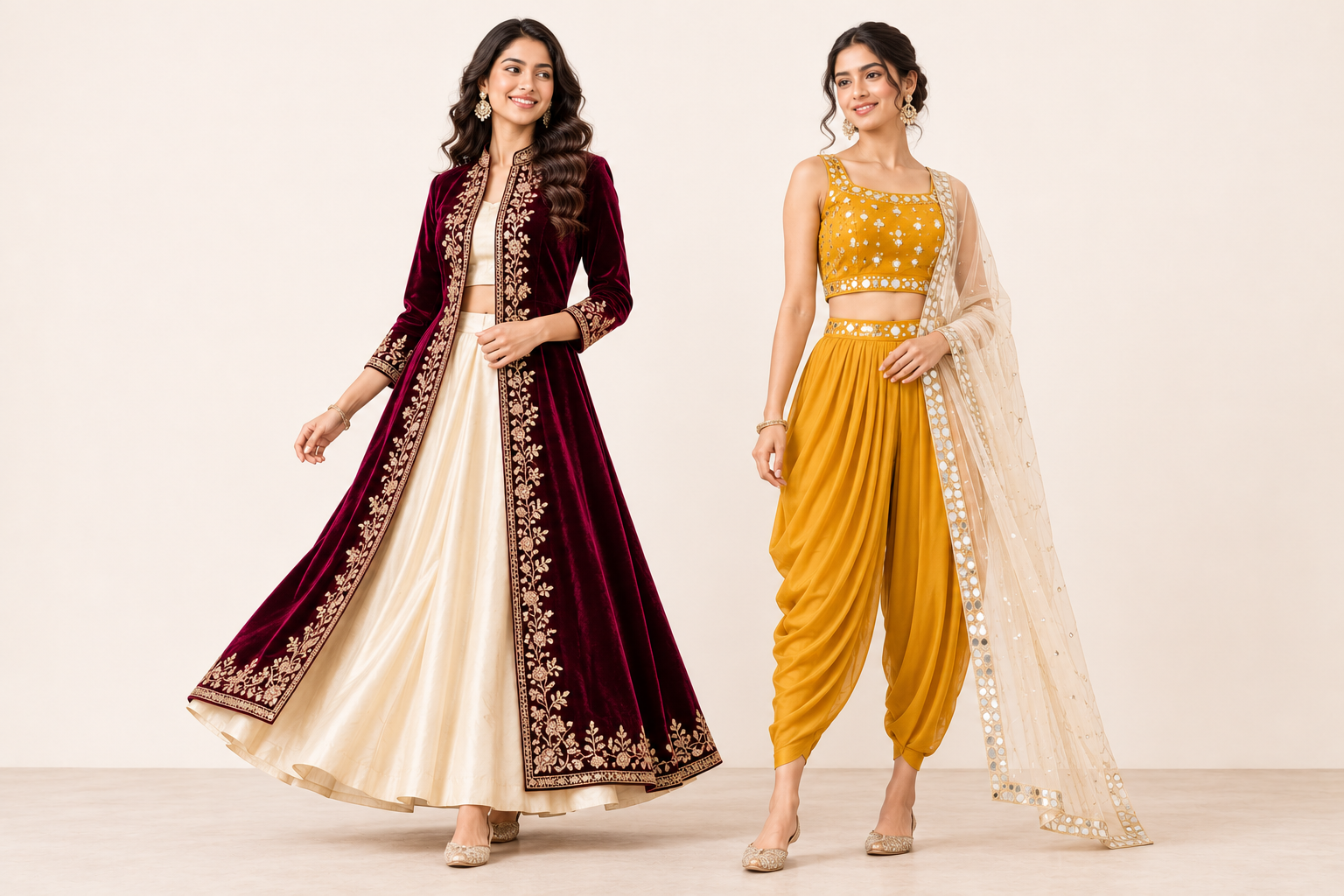
1. Dhoti pants with a crop top or short kurta
Dhoti pants are draped at the front and gathered at the ankle, which gives a relaxed, flowing shape without the weight of a full skirt. Paired with an embellished crop top, a peplum top or a short kurta, they make one of the most comfortable festive outfits you can wear.
Best for: mehendi, haldi, sangeet and pujas, or any function where you will sit on the floor or dance.
Styling tip: keep the dhoti plain or lightly textured and let the top carry the embroidery. Our Dhoti Pants with Embellished Crop Top follows exactly this balance.
2. Cape gown or cape lehenga
A cape replaces the dupatta with a sheer or embroidered layer that falls from the shoulders. It looks regal, photographs beautifully and frees your hands, because there is no dupatta to keep adjusting.
Best for: receptions, engagements and cocktail evenings.
Styling tip: a cape adds volume at the shoulders, so keep the neckline clean and the jewellery to earrings only.
3. Pant saree
A pant saree swaps the petticoat for fitted cigarette pants or flared trousers, with the pallu draped as usual. It gives you the grace of a saree with far more freedom to walk, climb stairs and dance.
Best for: cocktail parties, office celebrations and anyone who loves sarees but finds draping tiring.
Styling tip: a structured blouse, such as a corset or high-neck style, makes the pant saree look deliberate and modern.
4. Long jacket with a skirt or palazzo
A long open jacket, often in velvet, brocade or embroidered silk, worn over a simple skirt, palazzo or slim pants. It is warm, elegant and very practical for winter weddings in the NCR, when evening functions outdoors can get cold.
Best for: winter functions, sangeet nights and family dinners.
Styling tip: see our Velvet Jacket with Skirt Set for a jacket that works as the main statement piece.
5. Draped dhoti gown
This is a gown with a draped, dhoti-style front panel, sometimes with a slit. It has the length and drama of a gown with a distinctly Indian drape at the front.
Best for: receptions and cocktail nights where you want to look formal without wearing a lehenga.
Styling tip: fluid fabrics such as crepe, satin and georgette hold the drape best.
6. Ruffle skirt or ruffle saree set
Layers of soft ruffles on a skirt or a pre-stitched saree add movement and a lighter, romantic feel. Paired with an embroidered crop jacket or blouse, the look stays festive without heavy embroidery all over.
Best for: day functions, mehendi and engagements.
Styling tip: our Ruffle Skirt with Crop Jacket Fusion Set is a good starting point if you want to adapt colours or sleeve length.
7. Indo Western co-ord set
A matching top and bottom in the same fabric, finished with Indian embellishment such as mirror work, sequins or gota. Co-ords look polished with almost no effort and are easy to re-wear by splitting the pieces.
Best for: pre-wedding parties, festive house parties and travel to destination functions.
Styling tip: if you are unsure between a co-ord and a crop-top lehenga, our comparison of co-ord sets and crop-top lehengas will help.
8. Peplum top with sharara or skirt
A peplum top is fitted at the waist and flares out into a short frill. With a sharara or flared skirt underneath, it gives a lovely defined waist and a lot of movement below.
Best for: sangeet, Diwali and Eid gatherings.
Styling tip: a peplum that ends at the high hip suits most heights. Petite women often prefer a slightly shorter peplum to keep the leg line long.
9. Asymmetric tunic with cigarette pants
A long tunic with an uneven hem, a high-low cut or a side drape, worn with slim pants. It is the most understated style on this list, which is exactly why many women choose it for workplace celebrations and smaller family events.
Best for: office festive days, kitty parties and pujas.
Styling tip: add a statement dupatta or a belt to make it feel more festive in the evening.
10. Belted saree gown
A saree gown looks like a draped saree but is stitched into one piece, often with a metallic or embroidered belt at the waist. It takes minutes to put on and stays in place all evening.
Best for: receptions, cocktail nights and anyone who wants a saree look without the draping.
Styling tip: if you like this idea, read our guide to pre-draped sarees as well.
How to choose the right Indo Western dress
With so many options, it helps to narrow your choice in this order: occasion first, then comfort, then fabric, and only then the details.
Start with the occasion
- Mehendi and haldi: light, breathable and easy to sit in. Dhoti sets, ruffle sets and co-ords in cotton silk, georgette or chanderi work well.
- Sangeet: something you can dance in for hours. Dhoti sets, peplum and sharara, co-ords and pant sarees.
- Cocktail and reception: more structure and shine. Cape gowns, draped dhoti gowns, belted saree gowns and pant sarees in satin, crepe or embellished net.
- Office and small family events: asymmetric tunics, simple co-ords and jacket sets.
Think honestly about comfort
Ask yourself how long you will wear the outfit, whether you will sit on the floor, how much you will dance and whether the event is indoors or outdoors. A beautiful outfit that you keep adjusting all night will not feel beautiful for long. This is where Indo Western styles often beat traditional wear: fewer loose layers, no heavy dupatta and more freedom to move.
Choose fabric for the season
- Winter (November to February): velvet, raw silk, brocade and heavier crepe. Jackets and capes add warmth for outdoor evenings.
- Summer and monsoon: georgette, chiffon, cotton silk, chanderi and organza, which breathe and dry quickly.
- All-year: crepe and satin, which drape well and photograph with a soft sheen.
For more detail on how each fabric behaves, see our guide to chiffon, velvet, satin and georgette.
Dress for your shape, not against it
Every body can wear Indo Western clothing well; it is mostly a question of where you place the volume and the embellishment.
- If you want to define your waist, look at peplum tops, belted saree gowns and fitted jackets.
- If you want to add height, choose long vertical lines: floor-length capes, a long jacket left open, or a pant saree in one colour.
- If you prefer comfort around the middle, dhoti pants, A-line tunics and drapes are kinder than very fitted waistbands.
- If you have broad shoulders, a V or sweetheart neckline balances them better than a heavy cape.
These are suggestions, not rules. A good tailor will adjust the cut so the outfit works for you rather than asking you to fit the outfit.
Keep the balance
Pick one hero element: the embroidery, the colour, the drape or the silhouette. Let the rest support it. A heavily embroidered crop top looks best with plain dhoti pants. A dramatic cape looks best over a clean gown. When in doubt, take one thing away.
Why custom stitching makes such a difference
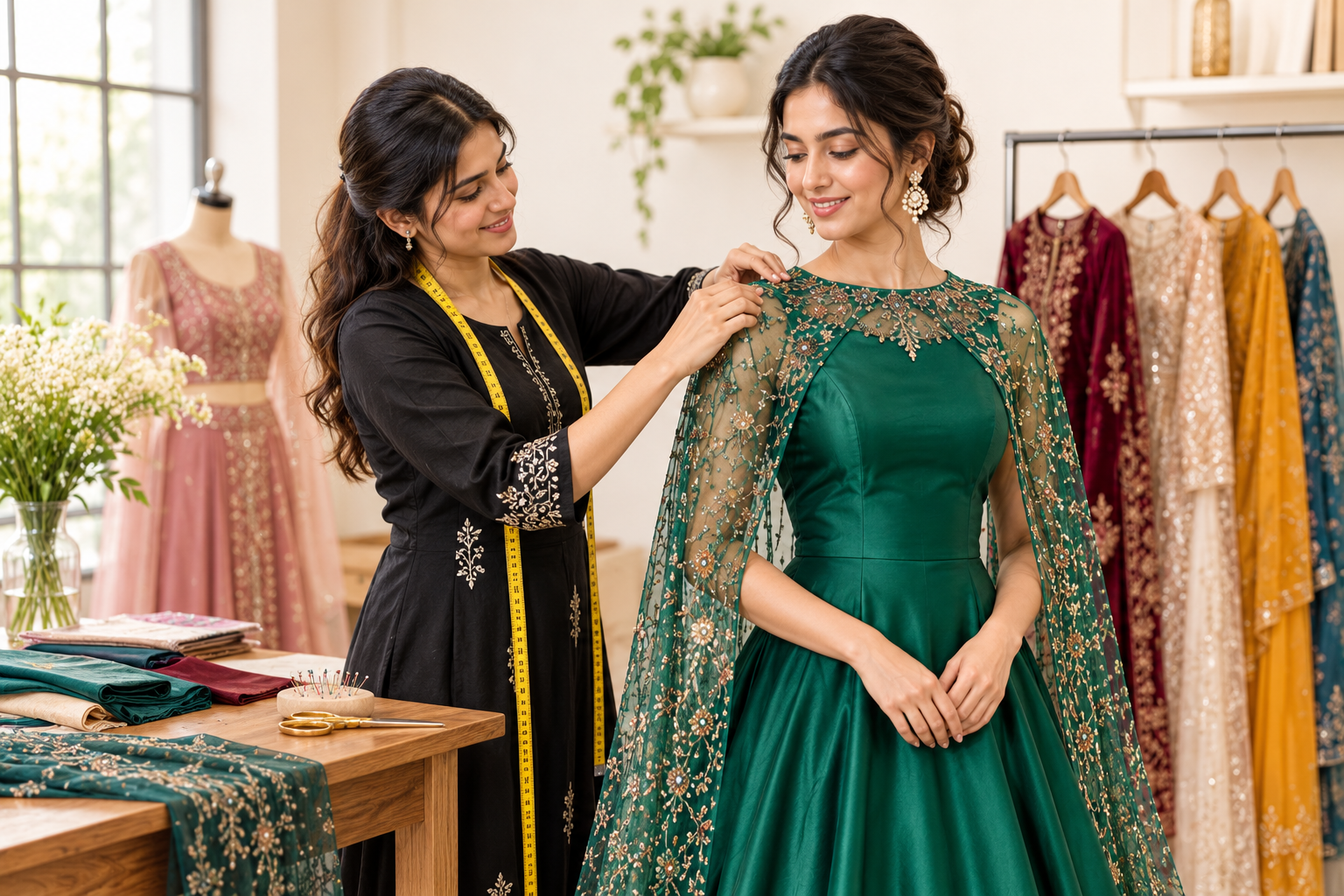
Indo Western outfits depend on cut more than almost any other Indian wear. A cape that sits a little too wide, a dhoti that drapes too low or a pant saree that is a few centimetres too long can make an expensive outfit look ordinary. Ready-made sizes rarely account for your height, shoulder width, waist position and the way you like clothes to fit.
At our Greater Noida studio, each outfit goes through the same four steps:
- Consultation: you share your occasion, budget and any reference photos, in the studio, on a call or on video.
- Design and fabric: we finalise the silhouette, fabric, colours and embroidery, or work with fabric you bring.
- Measurement and stitching: precise measurements are taken and the outfit is cut and stitched for you.
- Trial and finish: a trial fitting for adjustments, then final finishing and handover.
You can read more about each stage on our process page.
Frequently asked questions
Can I wear an Indo Western dress to a wedding?
Yes. Indo Western outfits are now very common at weddings, especially for sangeet, cocktail and reception functions. For the main ceremony, choose richer fabrics and traditional colours if the family prefers a more classic look.
Are Indo Western dresses suitable for older women?
Absolutely. Long jackets with palazzos, asymmetric tunics, pant sarees and saree gowns are elegant at any age. The key is choosing a cut and sleeve length you feel comfortable in.
Can you recreate an Indo Western dress from a photo?
Yes. Share a photo or a Pinterest idea and we will tell you how closely it can be recreated, and what we would adjust for your body, your fabric and your event.
How early should I order a custom Indo Western outfit?
As early as you can, especially in the wedding season. Heavier embroidery takes more time, so tell us your event date at the first consultation and we will confirm a timeline once the design is final.
Find your Indo Western style
You can browse our Indo-Western Fusion collection for ideas, or bring your own design. Either way, every piece is measured, cut and stitched for you at our studio in Greater Noida.
Book a consultation or message us on WhatsApp with your occasion and a reference photo, and we will help you shape the rest.
Want an outfit like this?
Book a Consultation